Cost
Day-school tuition has climbed beyond the reach of a widening share of families, forcing communities to choose between quality and access.

Jewish Education AI
A shared, non-profit infrastructure that gives every Jewish learner — in any community, at any age — a study partner. Built once for the whole field: every institution shapes what it teaches, and the grid itself takes no side.
01 The Challenge
It happens through dialogue, relationship and challenge. Three structural constraints now stand between that and most Jewish learners — and the clock on AI is already running.
Day-school tuition has climbed beyond the reach of a widening share of families, forcing communities to choose between quality and access.
There are not enough qualified Jewish educators, and the ones in place are stretched thin by the routine work of differentiating for every learner in the room.
Millions of young Jews in the geographic periphery are simply unreached. No teacher-dependent model has ever been able to get to them.
No previous technology has been able to address all three constraints at once. This one can.
Personal tutoring at a cost per learner a community can actually carry, rather than a privilege that tracks tuition.
Routine differentiation handled by the system, so scarce educators spend their hours on the work only a person can do.
A learner in a community of forty Jews gets the same companion as one in a large day school.
Every one of those three answers assumes an AI built for Jewish learning. That is not the AI that is arriving. Off-the-shelf commercial AI is optimised for test drills and engagement metrics. It is very good at what it was built for, and it was not built for us: it has no idea that Jewish learning happens by arguing.
The core architecture and safety norms of educational AI are being set over the next two years, and independent development is beyond the reach of any single school. Left to the market, the wealthiest schools buy in and the rest do without — and the ones who do buy in will be teaching Judaism through a product built by people who never asked what it needs.
So the answer is not less AI. It is AI built from the ground up around Jewish pedagogy — by the field, for the field.
The Jewish world can build its own shared infrastructure today, or inherit someone else's tomorrow.
02 The Idea
No community builds its own power station. It plugs into a grid — shared, regulated, engineered once to a standard no single participant could afford alone. JEDAI applies that logic to Jewish learning.
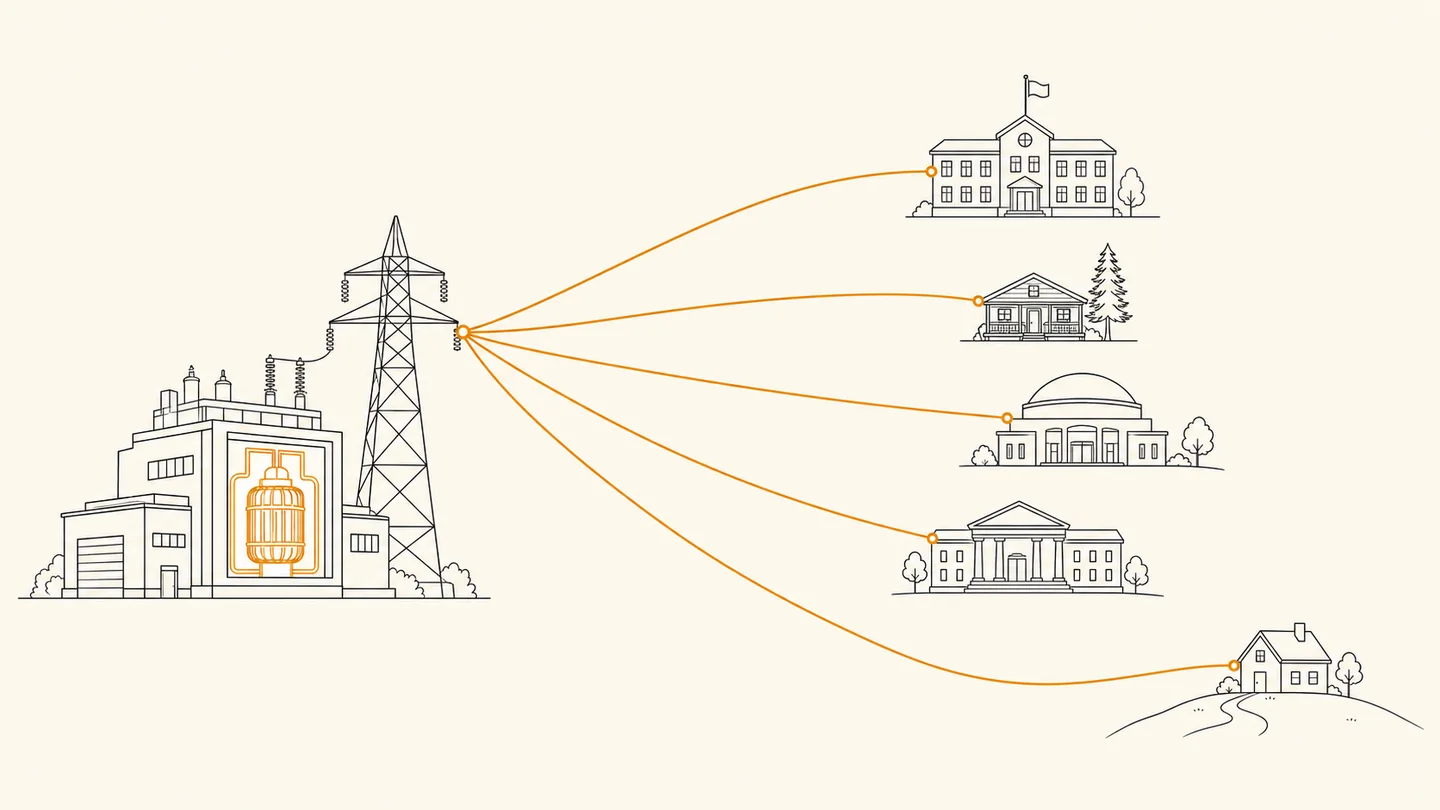
A single high-performance core — pedagogy, safety architecture, personalisation engine, avatar interface — engineered to a standard no individual institution could reach on its own.
The core is domain-agnostic. It does not encode one curriculum; it carries whichever the field loads onto it. Hebrew and Holocaust education are being built first, and everything after them uses the same infrastructure.
Any school, camp, campus, youth movement or congregation connects to the same core and stays connected. The capability does not have to be rebuilt for each institution that joins.
03 How Learners Meet It
JEDAI is a single avatar that grows with the learner. It begins inside the classroom, where the teacher stays in command — and keeps going, past the classroom, for the rest of a learning life.
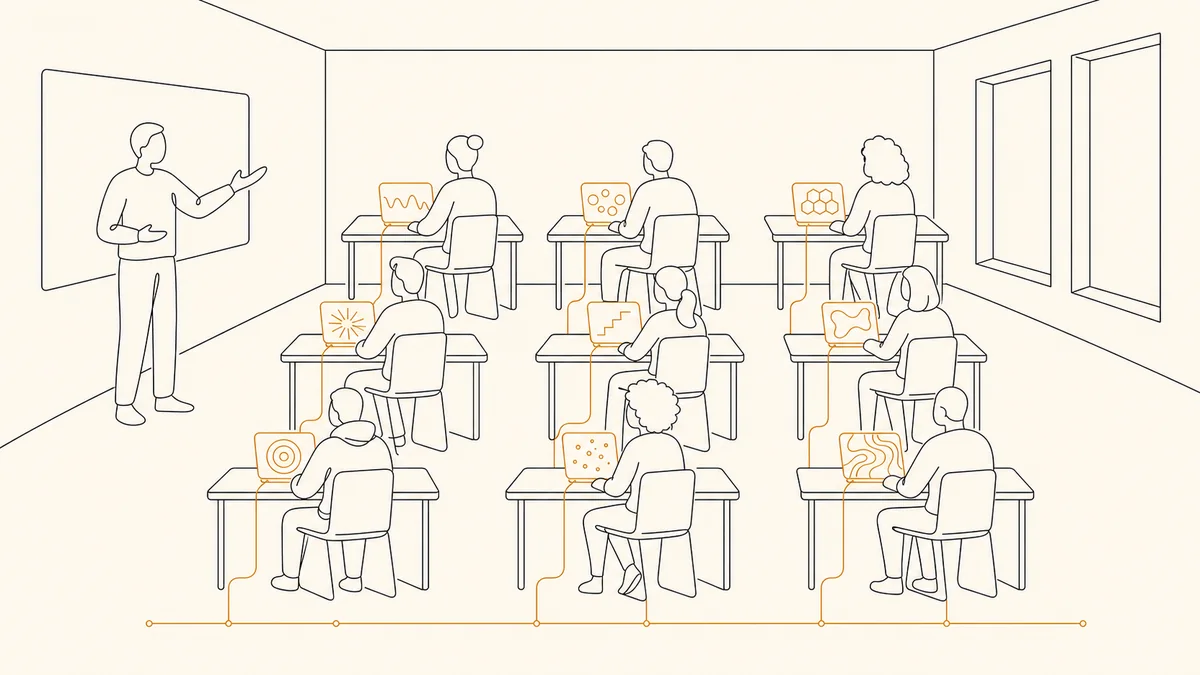
Tier one · In classrooms January 2027
A personal tutor for every student — and a personal assistant for every teacher.
No one can differentiate a single lesson thirty ways in real time. The Classroom Tutor is how one teacher reaches every learner in the room individually: each student working at exactly their own level, inside the lesson their teacher designed. It does not stand in for the teacher. It extends the teacher's reach to every student at once.
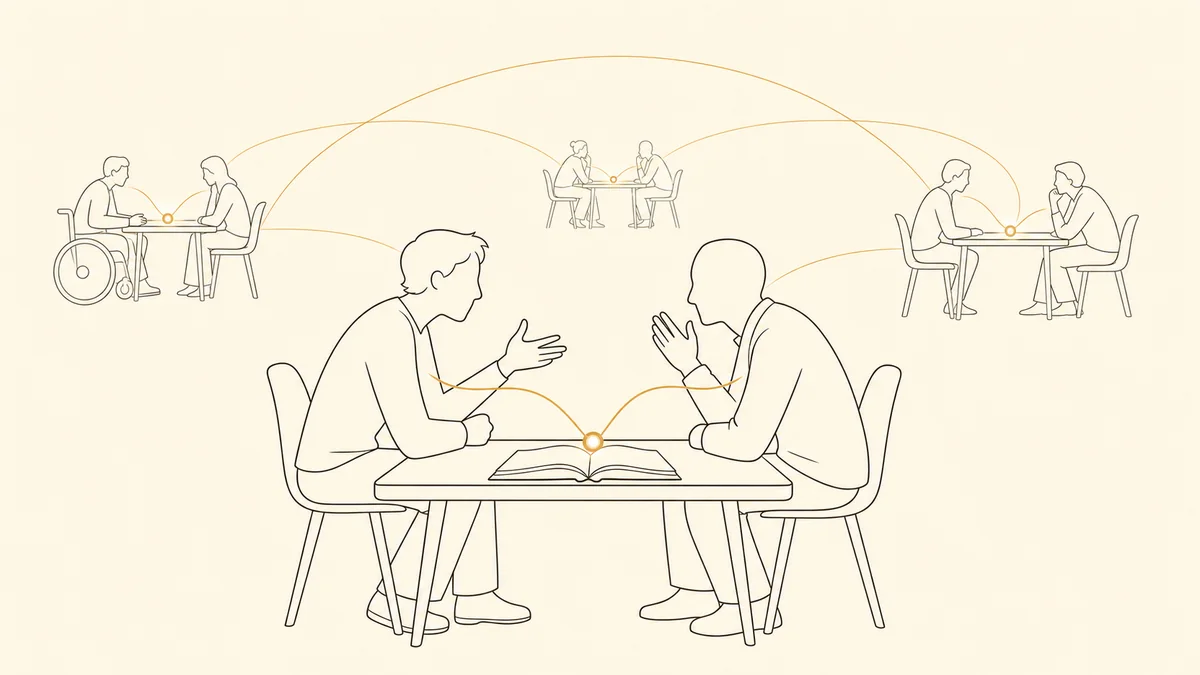
Tier two · In development
A study partner for life — one that argues back.
Chavruta is the heart of JEDAI. It teaches through dialogue rather than drills: questioning, pushing, conceding, and deliberately taking the opposing side — the way a real study partner does. It does not deliver content to a learner. It thinks with them.
Much of what forms a Jewish life happens off the schedule: the night before a first trip to Israel, the argument in a dormitory corridor, the question on the walk home from camp. Even the finest educator — and the field has many — cannot be there at two in the morning, or in thirty places at once.
A nineteen-year-old, a week before her first trip to Israel, is watching the news and quietly deciding she might not go. Her hesitation has nothing to do with logistics. It is about walking into a conflict she does not feel equipped to understand, and whether going means taking a side she has not thought through. Her programme's materials are thorough, but the next session is days away and this feeling is not waiting. So she does what anyone her age would do at midnight: she opens a general-purpose chatbot and asks it to explain the conflict. It gives her a fast, confident answer flattened into a story of good and bad. She now has an answer. She does not have the understanding she needed, and the doubt that almost made her cancel has not moved.
Preparation in the weeks before departure, accompaniment while they are there, and reflection once they are home — so a formative ten days stops evaporating on the flight back.
The intensity of a summer has always been followed by eleven quiet months. A companion extends the relational work of counsellors, hosts and rabbis into the gaps between gatherings.
The years in which Jewish questions become most pressing are the years in which institutional Jewish education mostly stops. A partner who already knows a learner does not start over at eighteen.
Unaffiliated families, interfaith households, isolated communities, adults who were never given a Jewish education and will not enrol in one now. Almost nothing reaches them today. A companion can.
Two things have always limited Jewish education: how many gifted educators exist, and where a learner happens to live. A companion bound to no room, no timetable and no country does not ease those limits — it removes them.
Jewish learning is a relationship, not a transaction. Everything in the system is built to that.
The default move is a question that opens the problem, not a fact that closes it.
Machloket — structured disagreement — is a method, not a malfunction. The partner is built to press.
Continuity is the point. A partner who recalls what you struggled with three years ago can teach you things a fresh tutor never could.
Guardrails are set by educators and made explicit, not inferred from an engagement objective.
Where a teacher, parent or rabbi belongs in the loop, the system routes toward them rather than around them.
04 Technology
JEDAI is not an experiment in whether personalised AI tutoring can work. That question has already been answered, at national scale, in a different subject. JEDAI takes a computational core with a proven record and rebuilds the pedagogy on top of it.
JEDAI does not begin from an empty screen. Its computational core is the Multi-Parameter Customization engine — MPC — developed by I-Teach, an Israeli learning-technology company. The engine has been in continuous operation since 2018 inside Israel's national education system.
Scale was not what decided it. Two requirements did: a study partner built from the ground up around Jewish pedagogy rather than a content-delivery product adapted to it, and a permanent commitment to at-cost pricing. I-Teach met both, and agreed to build the result as shared infrastructure owned by the field — not a platform owned by a vendor.
The method also predates the software. Twenty years of classroom teaching came first; the engine came after. What runs underneath JEDAI is a pedagogy tested on children long before it was written in code — not a course wrapped around a language model.
These figures describe the MPC engine's record in Israel's national school system — the proven foundation JEDAI builds on. They are not JEDAI outcomes. JEDAI's own results begin with the first pilot in January 2027.
Most educational software adapts to answers: get it wrong, get an easier question. MPC adapts to the learner. It maintains a continuously updated profile of each individual and adjusts in real time — not once a term, but inside the conversation as it happens.
Not just right and wrong: knowledge gaps, pace, persistence, interests, goals, learning style — seventeen of them in the Classroom Tutor, about twenty in Chavruta. A capable learner who is drifting needs the opposite of a confident one missing a foundation, and the engine can tell them apart.
Not only what comes next, but the tone it comes in and the kind of feedback that follows. The same idea reaches a hesitant learner and an impatient one in two different registers.
It accumulates across years and settings rather than resetting each session.
The engine was proven on mathematics and science. Nothing in it is mathematical. It can carry Hebrew, sacred text, Israel and peoplehood — and whatever the field adds after them.
What JEDAI builds is the part that does not exist yet: the Jewish pedagogy, the values architecture, the guardrails, the domain content, the chavruta interaction model, and the governance that keeps all of it in the field's hands.
05 Governance
Field-wide adoption depends on something stronger than good intentions. JEDAI is built so that it structurally cannot behave badly toward the institutions that rely on it.
JEDAI is being established as an independent non-profit public-benefit company (חל״צ) — a legal form whose purpose is the public good rather than returns to owners.
Institutions with deep expertise lead the fields they know best, and that leadership is real. What it never includes is a veto: no partner can shut another institution out of a field of learning, restrict what it teaches, or impose its reading on anyone else's learners.
Pedagogy, content, values boundaries and the research agenda are set by the Educational Vision and Design Council: practising Jewish educators and scholars from across the movements. Its published principles apply to every domain on the grid.
JEDAI is not a commercial venture and has no market to win. It does not recruit learners, sell to your constituents, or profit from your dependence on it.
The pedagogy is the field's: curricula, learning objectives, values architecture, guardrails. Learning records stay open and portable — including to another provider. At-cost pricing holds beyond the life of any single engagement. The engine and the code belong to those who build them; JEDAI holds no technology and wants none.
Outcomes are measured by an independent evaluator appointed by JEDAI — proficiency, and whether formative learning is actually taking place.
The engine records what a learner did with a problem — the time taken, the attempts made, the kind of error, which explanation finally worked. Persistence and engagement are read from those actions alone. Nothing from face, voice or physiology, which the EU AI Act prohibits in education.
Through a school, a camp or a movement, that institution's own educators decide. For a learner who comes alone — an unaffiliated adult, an interfaith family, a teenager in a community of forty Jews — three layers:
Institutions pay only the real, ongoing cost of running the grid — infrastructure, computing, maintenance and continued development. Never a markup, never a profit margin, and never licence fees that grow as the field's dependence on it grows.
Initiated and owned by
The Pincus Fund for Jewish Education Founder and owner. Supporting creative Jewish educational projects across the Diaspora since 1977.Founding partners

06 Partnership & Reach
JEDAI reaches learners through the organisations that already hold their trust. Your curriculum, your name, your learners — carried further than a programme calendar allows.
An umbrella organisation runs a superb ten-day programme for thousands of young adults a year. Two decades of curriculum work, and it shows: people arrive uncertain and leave changed. Then, every year, the same thing. They turn up barely prepared, and within a fortnight of landing home everyone is gone — not for want of content or conviction, but for want of anything that scales to thousands of individual people.
Your educators decide what is taught, which texts, which framings. JEDAI's pedagogy is dialogic; the positions in the room are yours.
The avatar sits inside your own programme, under your own branding. Participants meet it as yours, because it is.
Every field of learning is built with the organisations that hold authority in it. Partners design their domain; they do not receive it.
JEDAI has no learners of its own to win and nothing to sell your constituents.
Built for organisations like these
Built to carry fields of learning like these
Hebrew and Shoah education are in build now, launching January 2027. Everything after them runs on the same infrastructure.
The engine is proven and running. Hebrew and Shoah education enter classrooms in January 2027, across four continents.
Roughly eighteen to twenty months of development to bring the lifelong dialogic companion to launch.
Progressive rollout across the partner network and the full set of content domains.
Successive platform generations, so the grid keeps pace with the technology beneath it.
07 Stewardship
Two teams, two distinct responsibilities. JEDAI sets the educational priorities, the values alignment and the work with institutions in the field. I-Teach builds and operates the computational core. The separation is deliberate: neither side can quietly become the other.
Educational vision, values architecture, governance, and implementation with institutions across the field.
Engineering leadership behind the Multi-Parameter Customization engine. Unit 8200 and Technion alumni.
Division of roles: I-Teach builds and runs the engine. JEDAI decides what the engine is for — the pedagogy, the values boundaries, the content priorities, and the terms on which institutions plug in.
Domain leadership: Every content domain has its own pedagogical lead — the authority who sets the learning objectives, the assessment logic and the rules the engine works under, and who approves quality before anything reaches a classroom.
08 Get Involved
The architecture of educational AI is being settled now, by people who are not asking what Jewish learning needs. There is a short window in which the Jewish world can build its own, on its own terms. It will not stay open.
JEDAI is being built with the schools, umbrella organisations, educators and researchers who want a say in what a shared Jewish learning infrastructure becomes. If your organisation has learners to reach, content worth carrying, or a view on how this ought to be done — that conversation is open.
JEDAI (in formation) · An initiative of the Pincus Fund for Jewish Education · Jerusalem